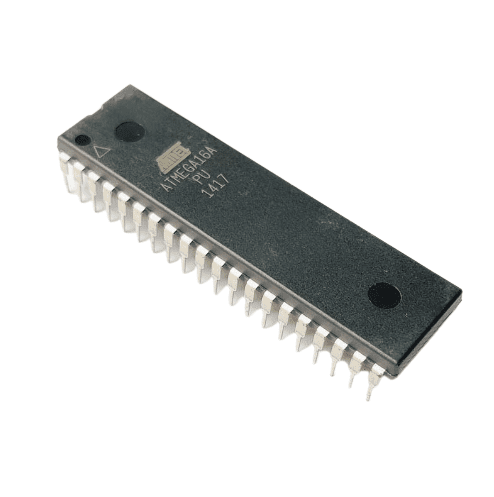
Description
-
Microcontroller Core: The ATmega16A operates at a clock frequency of up to 16 MHz and is based on the AVR 8-bit RISC architecture.
-
Flash Memory: It has 16KB of Flash memory for program storage, where you can load your embedded software.
-
SRAM: The IC includes 1KB of SRAM (Static Random-Access Memory) for data storage and manipulation during program execution.
-
EEPROM: It has 512 bytes of EEPROM (Electrically Erasable Programmable Read-Only Memory), which can be used for non-volatile data storage.
-
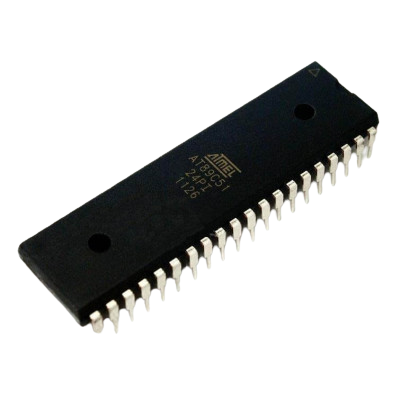
I/O Pins: The ATmega16A provides a variety of digital and analog I/O pins. It typically comes in a 40-pin dual in-line package (DIP) with 32 I/O pins.
-
Analog-to-Digital Converter (ADC): It features an 8-bit ADC with up to 8 analog input channels, allowing you to measure analog voltages.
-
Timers and Counters: The microcontroller includes several timers and counters, including 16-bit timers, which can be used for various timing and control applications.
-
Communication Interfaces: It supports serial communication through UART (Universal Asynchronous Receiver-Transmitter) and SPI (Serial Peripheral Interface), making it suitable for interfacing with other devices and sensors.
-
Clock Options: The ATmega16A can be configured to use an external crystal oscillator, an internal oscillator, or an external clock source, providing flexibility in clocking options.
-
Low Power Modes: It offers low-power sleep modes, which are useful for battery-powered and energy-efficient applications.
-
Programming: You can program the ATmega16A using standard programming tools and languages such as C/C++ with the AVR-GCC compiler.
-
Applications: The ATmega16A is used in a wide range of applications, including industrial control systems, home automation, robotics, educational projects, and more.