Description
-
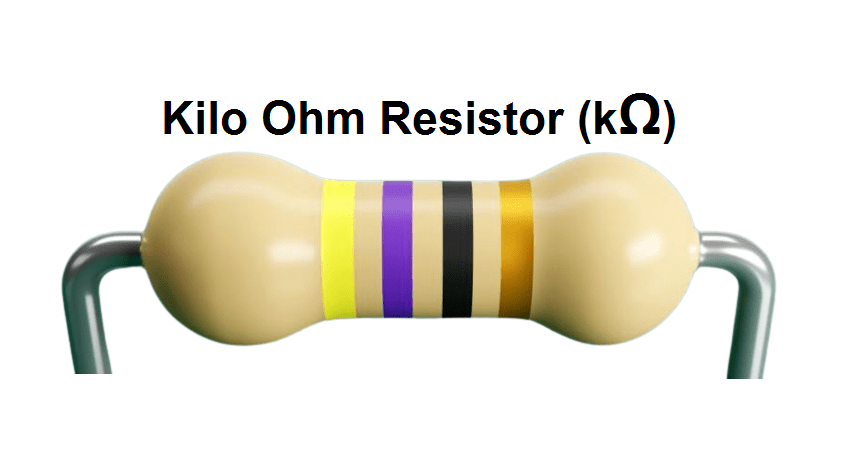
Resistance Value: A kilo ohm resistor has a resistance value of 1,000 ohms. This is equivalent to 1 kilo ohm or 1 kΩ.
-
Tolerance: Resistors typically have a tolerance rating, which indicates the allowable variation in their resistance value. Common tolerance values for resistors include 1%, 5%, and 10%. For precision applications, you may choose a 1% tolerance resistor, while 5% and 10% tolerance resistors are more common for general use.
-
Power Rating: The power rating of a resistor, measured in watts (W), indicates the maximum amount of power it can safely dissipate without getting damaged or changing its resistance significantly. Common power ratings for kilo ohm resistors are 1/8 watt (0.125W), 1/4 watt (0.25W), and 1/2 watt (0.5W). Higher-power resistors are also available for applications requiring greater power dissipation.
-
Package Type: Kilo ohm resistors are available in various package types, including through-hole and surface-mount. Through-hole resistors have wire leads for easy soldering onto a circuit board, while surface-mount resistors are designed to be directly mounted onto the surface of a PCB.
-
Composition: Kilo ohm resistors can be made from various materials, including carbon composition, metal film, metal oxide, and thick-film materials. The choice of resistor composition can impact factors like stability, temperature coefficient, and cost.
-
Temperature Coefficient: The temperature coefficient of a resistor indicates how its resistance changes with temperature. It is expressed in parts per million per degree Celsius (ppm/°C). Common temperature coefficients include 100 ppm/°C, 50 ppm/°C, and 25 ppm/°C. A lower ppm/°C value means that the resistor’s resistance is more stable over a range of temperatures.
-
Voltage Rating: While resistors are primarily rated by their power dissipation capability, they also have a voltage rating that specifies the maximum voltage they can safely handle. Ensure that the voltage across the resistor does not exceed this rating to prevent breakdown or damage.