Arduino Uno Mastery — 20-Day Live Programme (Online or 1:1 at Home)
About Course
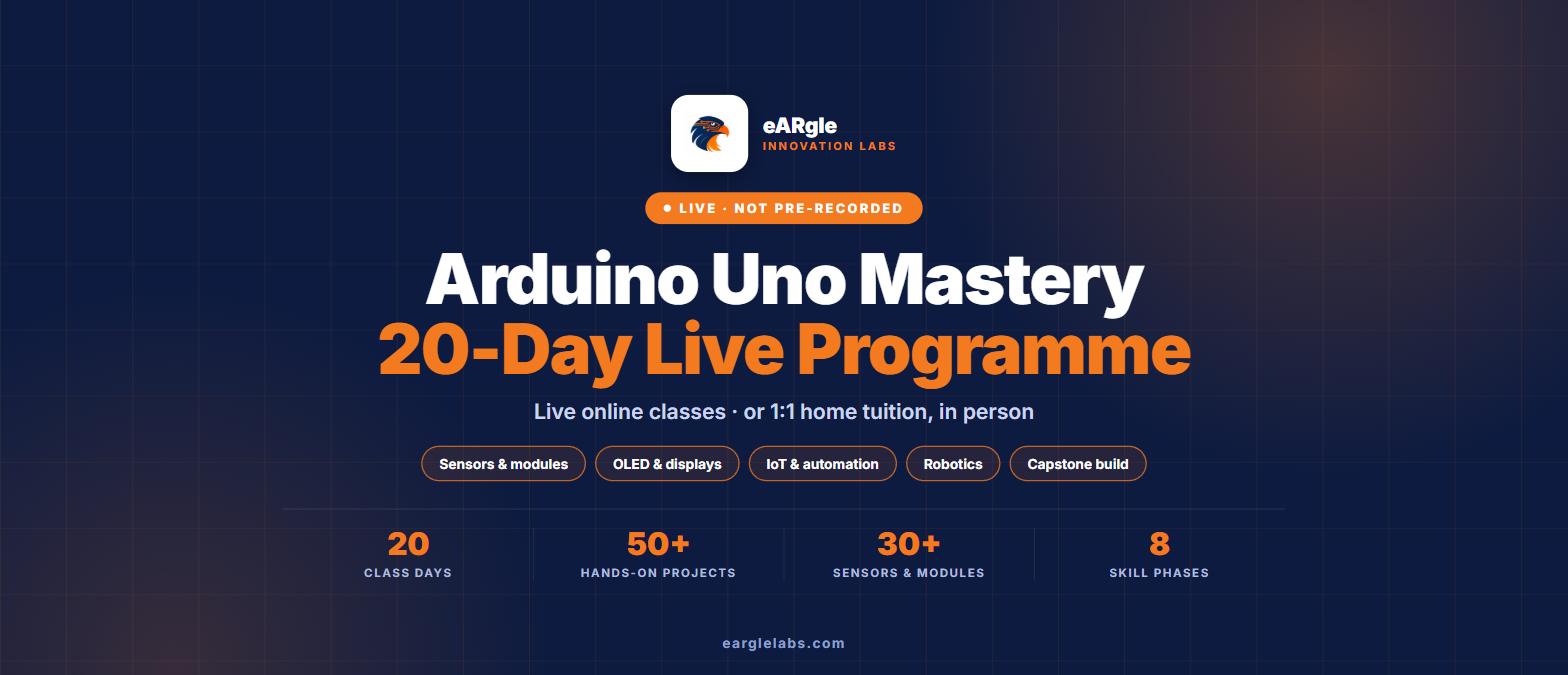
This is a live, taught programme — not a pre-recorded course. Over 20 class days you work through 30+ sensors and modules and build 50+ real projects, with the instructor on the other side of the screen (or at your table) the whole way. Every session opens with how the day’s sensor actually works and ends with something running on your bench.
Two ways to take it
Same 20-day syllabus, same mentor. Choose the format that fits you.
Live Online Class
Small live batches over video. You build along on your own bench, with screen-share debugging whenever something refuses to work.
1:1 Home Tuition
The same programme taught in person at your home, one learner at a time, on a schedule you set.
Already have your own components? Take the course on its own at ₹5,499. Want only the hardware? The eARgle Arduino Fundamentals Kit is ₹6,999 on its own.
How the course works
Built around real projects, not slides.
Every session opens with the fundamentals of the day’s sensor — how it works and where it’s used in the real world.
Theory is followed straight away by wiring and code, so the learning sticks through doing.
The OLED is taught once and reused in every project, so focus stays on the new sensor each day.
On two-sensor days you build one project per sensor plus a combined build — three outcomes in a session.
The curriculum — 20 days, 8 phases
Duration key: 2 hrs standard · 2.5–3 hrs two-sensor / three-project days · 3–4 hrs big builds. Each phase is colour-coded by what you are working with.
Light & security
Environment & agriculture
Motion & distance
Control & actuation
Access, time & comms
Health & biomedical
Robotics & comms
Arduino & IDE setup, breadboard basics, current-limiting resistors, first LED blink, first analog read with the LDR. Build: light-triggered LED.
I2C explained simply, OLED library setup, text/shapes/animation, button debouncing, buzzer feedback and a reusable dashboard template. Builds: welcome screen, button counter, reaction-time game.
Voltage dividers, light mapping, laser safety, beam-break logic. Builds: smart night lamp, laser indicator, laser tripwire alarm.
Capacitive touch vs mechanical buttons, tap detection, toggle vs momentary logic. Builds: touch toggle lamp, knock alarm, secure tamper box.
One-wire vs I2C on the same bus; temperature, humidity, pressure and altitude. Builds: room comfort meter, pressure display, mini weather station.
Gas-sensor warm-up, analog gas readings, calibration and safe thresholds. Builds: air-quality monitor, breathalyser, environment safety station.
Analog soil conductivity, rain detection, mapping readings to a percentage. Builds: plant “water me” alert, rain detector, smart garden monitor.
Relays as isolated switches, driving a DC pump safely, full automation logic. Builds: tank level meter, manual pump control, automatic irrigation system.
Echo/trigger timing, sound-to-distance maths, smoothing noisy readings. Builds: digital distance meter, parking / blind-stick assistant.
Active IR vs passive infrared, delay and sensitivity tuning, cutting false triggers. Builds: people counter, motion-activated light, entrance security + visitor counter.
Acceleration and rotation over I2C, tilt angles, simple motion detection. Builds: digital spirit level, tilt/fall alarm with step counter.
Two-axis analog reading, PWM and servo angle control, mapping input to motion. Builds: joystick visualiser, servo angle control, joystick-controlled pan mount.
Variable-resistance bend sensing, mapping bend to angle, an introduction to wearables and assistive tech. Builds: bend meter, gesture-controlled robotic finger.
Matrix keypad scanning, password logic, RFID UID allow-lists, driving a lock via relay. Builds: PIN door lock, card access/attendance, two-factor smart lock.
Decoding IR remote codes, serial commands to the MP3 module, SD playback and volume control. Builds: remote control panel, music player, remote-controlled audio doorbell.
Battery-backed real-time clock, scrolling text and animation on an 8×8 matrix. Builds: accurate clock with alarms, scrolling message board, desk clock combo.
Optical pulse and oxygen sensing, ECG signal basics, plotting waveforms, electrode placement and safety. Builds: pulse oximeter, ECG waveform monitor, personal health dashboard. Taught as learning tools — not medical devices. Safety and ethics are discussed.
DC motors, L298N driver, PWM speed and direction, 18650 + buck-converter power, HC-05 pairing and serial commands. Build: phone-controlled robot car. Optional add-on: ultrasonic obstacle-avoid mode.
GSM SIM setup, SMS and calls via AT commands, GPS latitude/longitude, parsing NMEA data and satellite fix. Builds: SMS alert sender, location display, SMS-my-location tracker. GSM and GPS modules are add-ons, not part of the base kit.
System design from sensors to logic to outputs; planning, building and presenting an original project. Themes: smart home, smart agriculture, security suite. Each learner presents their build — a confidence boost and a portfolio piece.
Start anywhere. Build everything.
Join at the level that fits and grow all the way to robotics and standalone communication systems.
Foundations, the OLED display, light, security and environment sensors — ending with an automated irrigation build.
Motion, distance, controllers, access control, time, communication and biomedical sensors.
Bluetooth robot car, standalone GSM + GPS systems and an original capstone project.
The kit that goes with it
The eARgle Arduino Uno R3 IoT & Robotics Ultimate Learning Kit — 60+ premium components covering every sensor, display, driver and module in the syllabus, plus the 4WD robot chassis for Day 18. Nothing in the kit goes unused, and nothing in the course needs a substitution note.
Your mentor
This programme is designed and taught directly by the founder of eARgle — built on real product-engineering and assistive-technology experience.
Founder & Director, eARgle
Arun is the founder of eARgle, an IoT and AI-driven assistive-technology startup focused on empowering individuals with disabilities. He specialises in embedded systems, IoT and intelligent automation, with a vision to build affordable, impactful solutions that improve independence and quality of life. Under his leadership eARgle has grown into two arms — a deep-tech product engineering company (eargle.tech) and a mentorship-first learning lab, eARgle Innovation Labs.
Book your seat
Pick Live online class or Home tuition, in person in the request panel on this page, tell us whether you want the kit box, and you’ll hear back the same day with batch dates and payment details.
Questions first? WhatsApp +91 93632 23926 or email eargletechnologies@gmail.com
What Will You Learn?
- Wire and program 30+ sensors and modules on the Arduino Uno, one at a time, with the reasoning behind each circuit
- Master one OLED dashboard template and reuse it across every project so focus stays on the new sensor
- Build complete systems, not demos: automatic irrigation, two-factor smart lock, entrance security, mini weather station
- Read analog and digital sensor data, map it to real units and set thresholds that trigger buzzers, LEDs, relays and motors
- Drive actuators safely: servos, DC motors through an L298N, relays and a water pump on external power
- Use I2C and SPI properly, and know why pin count matters on a 14-pin board
- Send and receive data over Bluetooth, RFID, IR remote and GSM, and read position from GPS
- Build and drive a phone-controlled 4WD robot car on 18650 power
- Read pulse, SpO2 and ECG waveforms as learning tools, with the safety and ethics that go with them
- Debug a circuit systematically instead of guessing, with the instructor watching your bench
- Design and present an original capstone project of your own from a blank breadboard