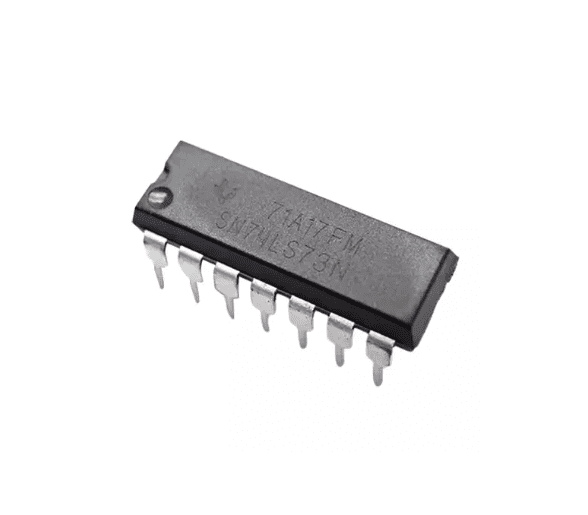
Description
-
Dual JK Flip-Flops: The 7473 IC contains two identical JK flip-flops within a single package. Each flip-flop has its own set of inputs and outputs, making it suitable for various applications where multiple flip-flops are needed.
-
JK Flip-Flop: The JK flip-flop is a type of sequential logic device with two inputs, J (set) and K (clear), and two outputs, Q (output) and Q’ (complementary output). It is used to store one bit of binary data and is known for its versatility in digital circuits.
-
Clock Inputs: Each flip-flop within the 7473 IC has a clock input (CP or CLK), which is used to control when data is latched or transferred within the flip-flop. On the rising or falling edge of the clock signal, data can be transferred from the J and K inputs to the Q and Q’ outputs.
-
Clear and Set Inputs: The 7473 IC provides clear (CLR) and set (SET) inputs for each flip-flop. These inputs allow you to reset (clear) or set the flip-flop to a specific state when certain conditions are met.
-
Asynchronous Inputs: The J and K inputs of each flip-flop can accept asynchronous logic inputs, meaning that the outputs can change state independently of the clock signal if the J and K inputs change.
-
Applications: JK flip-flops are widely used in digital systems for tasks such as data storage, frequency division, and sequence control. They can be used in counters, registers, and other sequential logic circuits.
-
Package: The 7473 IC is available in various package types, including DIP (Dual In-Line Package) and surface-mount variants.
-
Power Supply: It typically operates on a 5V DC power supply.
-
Truth Table: The 7473 IC has a truth table that defines its behavior based on the combinations of inputs (J, K, CLR, SET, and CLK). The truth table specifies how the flip-flops will behave in response to these inputs.