Description
Key Features:-
-
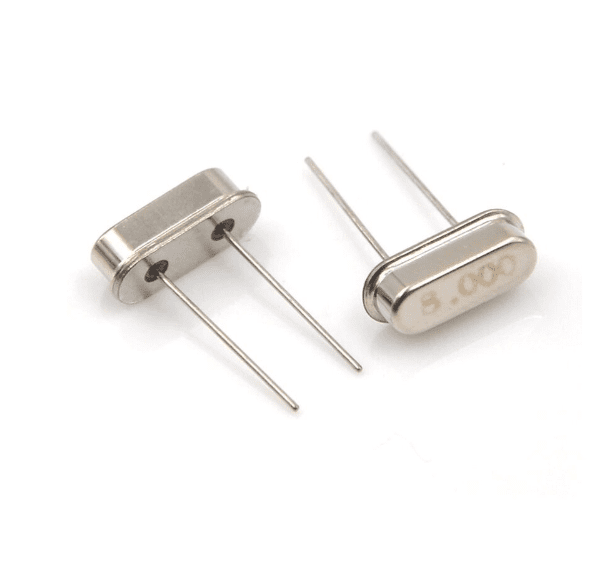
Frequency Accuracy: Crystal oscillators are known for their high-frequency accuracy and stability. An 8 MHz crystal oscillator provides a reliable and precise 8 MHz output.
-
Compact Size: These oscillators are available in compact package types and can be easily integrated into printed circuit boards (PCBs).
-
Two-Pin Configuration: Typically, crystal oscillators have two pins (usually labeled as "OUT" and "GND" or "VCC" and "GND") for connection to the circuit. They are straightforward to use and connect.
-
Low Power Consumption: 8 MHz oscillators are often designed for low power consumption, making them suitable for battery-powered devices and applications.
Applications:
-
Microcontrollers: Many microcontrollers incorporate an 8 MHz crystal oscillator as an external clock source. This oscillator provides the timing signal for the microcontroller’s operation, ensuring accurate execution of instructions.
-
Digital Logic Circuits: In digital logic circuits, an 8 MHz oscillator can be used as a clock source for synchronous operations, data sampling, and signal processing.
-
Communication Equipment: Some communication equipment, such as radio transceivers, may use an 8 MHz oscillator for timing and synchronization purposes.
-
Industrial Control Systems: In industrial automation and control systems, an 8 MHz oscillator can provide precise timing for various processes and sensors.
-
Test and Measurement Equipment: Oscilloscopes, signal generators, and other test and measurement instruments may use an 8 MHz oscillator for accurate signal analysis and generation.